
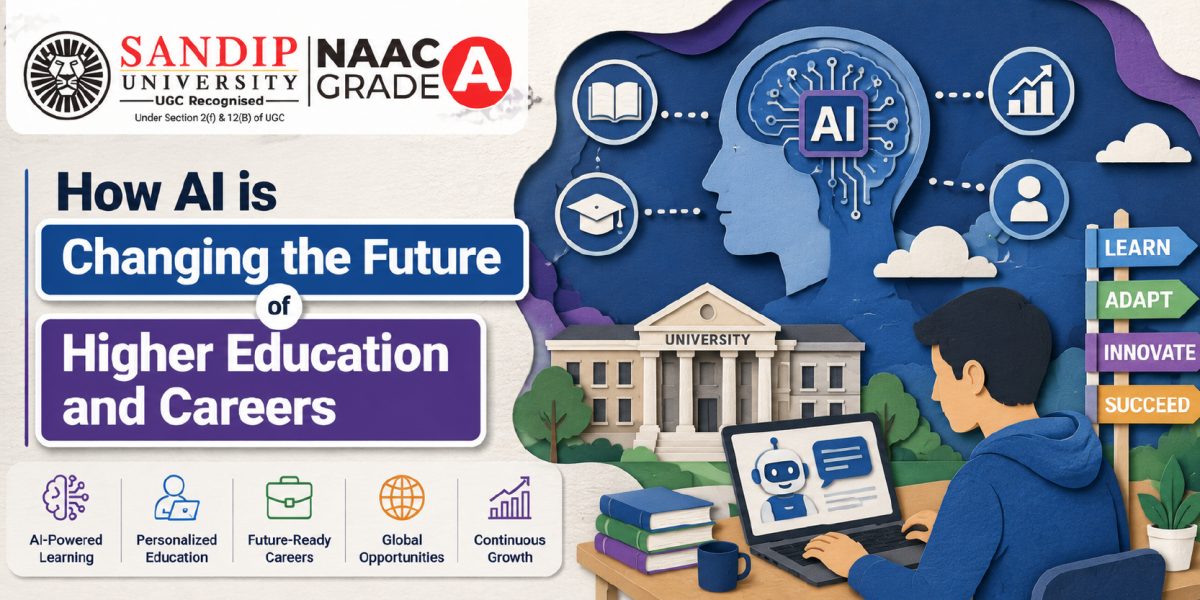
The education landscape is shifting rapidly with the help of many new technologies like artificial intelligence. This powerful technology is reshaping how students learn and how professionals work. Sandip University is a futuristic institution that embraces these changes with AI skills for students. Understanding this digital revolution will help students navigate their academic journey and secure a successful career.
How has AI Transformed the Classroom?
AI changes the traditional classroom dynamic by introducing smart tools that enhance learning in diverse ways”
A Personalised Learning Experience
Traditional education often follows a uniform model for all. AI breaks this old system completely. Smart algorithms analyse individual learning speed, academic strengths and weak points of students. The system then creates a customised study path just for students. The system skips ahead to advanced modules if students master a coding language quickly. This targeted approach saves time and reduces frustration.
Intelligent Tutors
Earlier, learning would stop outside the classroom. This is not true anymore as virtual assistants powered by AI are helping students solve problems on the go. These intelligent systems answer queries and help students understand difficult theories at any time as per the convenience of students. They do not simply give students the answers. Instead, they prompt students with helpful hints so they develop critical thinking skills.
Automated Grading Systems
Professors spend a lot of time every semester assigning grades to essays, quizzes and exams. This task is now made easier by AI systems. They are more accurate and much quicker in grading students. This automation helps faculty save time on grading and instead use that time to help students, conduct research or develop a better training strategy.
Immersive Virtual Classrooms
Classrooms are now no longer limited to the white board. AI systems are now integrated with virtual reality to create an immersive learning experience for students. Students engaged in the pharma field can perform complex experiments and research through this immersive experience. Engineering students can work with 3D models of bridges to test their structural integrity through AI. These high-tech virtual simulations help students learn theory with real-world applications.
Smart Campus Operations
AI drastically helps colleges manage the campus in an efficient manner. These systems help monitor hostels, manage library resources and streamline the admission process. AI chatbots are used efficiently by students to answer frequently asked questions about fee structures, hostel accommodation and course requirements. This integration of AI helps make the student experience seamless and easy to process.
What is the Future of Career Opportunities in the AI Era?
The job market reacts quickly to technological advancements. Future careers with artificial intelligence eliminate some traditional roles but creates millions of exciting new opportunities in diverse ways:
Rise of New Career Opportunities
Automation has now replaced repetitive and manual tasks. This shift has created a demand for skilled professionals who understand technology. Companies in fields like industries like healthcare and finance are looking for AI prompt engineers, data analysts, machine learning experts and cybersecurity officers.
Evolution of Traditional Roles
AI has not completely destroyed existing careers. Instead, AI has transformed these careers. Engineers use 3D models to design structures, pharmacists use AI systems to check if their research is viable, lawyers use AI software to scan massive legal documents to make case research easier. Graduates who have mastered AI tools relevant to their field have a bright future ahead.
What are the Critical Skills for the AI Era?
Technical knowledge alone will not guarantee career success. Students must develop a specific set of human skills that machines cannot replicate which include:
- Critical Thinking: AI can generate massive amounts of data but only humans can analyse it properly due to critical thinking skills.
- Creativity: AI machines can only follow patterns and rules. They are not creative beings like humans and lack the imagination for unique perspectives.
- Emotional Intelligence: Human leaders are needed to solve internal conflicts and manage human relations with sensitivity which is something AI cannot do.
- Adaptability: Technology is evolving every day and there is a need for humans to adapt to it by constant and lifelong learning.
How Does Sandip University Offer Future Ready Degree Programs in Nashik?
Sandip University is one of the best engineering colleges in Nashik that has adapted AI for the benefit of students. Sandip University’s future skills programs are designed to meet the demands of this new industrial era. We integrate cutting-edge AI concepts into our programs to include:
High-tech Skill Building Opportunities
Our students work directly in modern laboratories equipped with advanced computing tools. They build machine learning models, analyse big data sets and solve real industry problems before students graduate. This practical experience ensures that employers recognise their value immediately.
Holistic Student Development
Sandip University ensures that students gain technical skills and soft skills as a part of their learning experience. Many workshops are conducted to help students develop leadership and communication skills. Students are encouraged to work with AI systems while also developing their unique human strengths to become more employable professionals.
Advanced Industry Collaborations
Sandip University has partnered with diverse industry leaders to provide the best learning and career opportunities to students. These industry collaborations facilitate workshops, guest lectures, compulsory internships and placement opportunities for students. The goal is to train students with a dynamic learning experience.
Conclusion
AI represents a powerful partner and it is not a threat to a professional’s future. Graduates can be at the forefront of this exciting revolution by choosing an education path that embraces innovation. Be prepared to lead, adapt and thrive in the age of artificial intelligence. Good luck!
FAQs (Frequently Asked Questions)
1) What is AI in higher education?
Artificial Intelligence in higher education refers to the use of intelligent technologies that improve learning, automate academic processes and personalize education for students.
2) How does AI help college students?
AI helps students through personalized learning, virtual tutors, smart assessments, career guidance and adaptive study recommendations.
3) Will AI replace traditional careers?
No. AI is transforming careers rather than replacing them completely. Professionals who develop AI skills alongside human skills will have better career opportunities.
4) Why should students learn AI?
Learning AI helps students improve employability, develop future-ready skills and stay competitive in a technology-driven job market.