
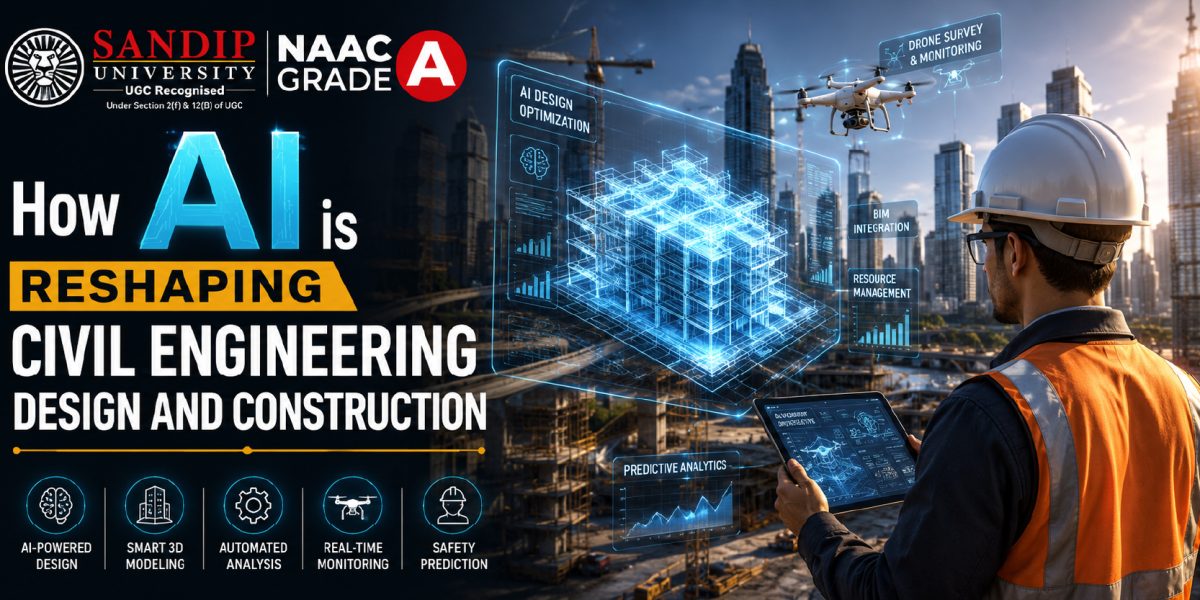
The modern skyline is changing every single day. Earlier, engineers drew plans on paper and workers relied entirely on traditional manual methods. Today, artificial intelligence is completely transforming this ancient industry. AI reshapes how we design, plan and build our infrastructure which is ushering in an era of extraordinary efficiency.
Engineers aspiring for modern civil engineering future careers face immense challenges. Rapid population growth in a nation like India demands faster residential and commercial construction development. Various natural and man-made challenges require more resilient public structures. Volatile material costs are a strain on development budgets while traditional construction methods often fail to meet these modern pressures.
AI offers a powerful solution to these modern problems. It processes vast amounts of data in seconds and finds structural patterns that humans may miss. This technology makes construction faster, safer and cheaper in the long run. Let us explore the role of AI in civil engineering:
How is AI Transforming the Design Phase with Generative Design?
AI completely changes this dynamic through generative design. Engineers simply input specific constraints into a specialised software program. These constraints include strict budget limits, material strengths, local environmental regulations and extreme weather metrics. The AI algorithm then takes over by generating thousands of viable design options in a matter of minutes.
AI also enhances Building Information Modelling, a popular civil engineering design software. This software creates detailed layered 3D digital models of buildings. AI automatically detects clashes between different structural systems by tracking these models in real time. For example, the AI notices immediately if a water pipe runs through a critical electrical beam and it alerts the engineering team before construction begins. This helps save cost and time of construction.
How is AI Used in Smarter Planning and Feasibility Studies?
AI accelerates the initial project planning phase significantly. Advanced algorithms analyse satellite imagery and historical geological data instantly. They predict how soil will shift under a heavy building over many decades. This predictive power helps engineers select the absolute best locations for deep foundations to reduce the risk of structural settling.
AI software also helps to optimise complex project scheduling. Large construction projects involve thousands of variable elements. Materials must arrive exactly when workers need them to avoid congestion and delays. Heavy machines must also move efficiently across the job site to maximise daily utility. AI software solves this logistical puzzle by creating dynamic schedules to ensure smarter planning.
What is the Impact of AI on Automating the Construction Site?
Construction companies use drones to capture high-resolution imagery construction sites every day. These drones map the entire site from above as they are armed with specialised cameras and laser scanners. AI software then processes these images to track daily progress. Project managers use this automated data to see exactly how much concrete is poured or how much steel is erected each day. This precise data removes human bias and guesswork from project management.
Robots are also entering the construction field to boost productivity. Autonomous bricklaying machines lay bricks much faster than human workers. Robotic bulldozers and excavators grade soil with extreme precision using AI sensors. These machines can work through the night without breaks unlike humans. Human workers can shift their focus away from manual labour toward more complex supervisory tasks.
What is the Role of AI in Enhancing Site Safety and Risk Management?
AI acts as a tireless safety supervisor through advanced computer vision. Safety managers connect AI software to standard site security cameras to scan the live video feed in real time. The AI instantly detects if a worker forgets their hard hat, ignores their safety vest or stands too close to an active excavation hazard. The system then sends an immediate alert to the site supervisor’s phone, allowing supervisors to correct behaviour and prevent accidents before they actually happen.
Construction management careers in India are all about minimising operational risks. AI also manages financial and operational risks effectively. The software identifies specific patterns that led to budgetary issues in previous years by evaluating data from past projects. It warns project managers about potential cost increases early which helps save time and money in the long run.
How Does AI Impact Smart Maintenance and Structural Health?
The role of artificial intelligence does not end when construction finishes. Instead, it continues to protect public structures throughout their entire operational lifespan. Engineers now build digital twins of physical infrastructure to monitor its long-term health. Specialised IoT sensors placed on the physical structure feed real-time data directly to this digital twin. These sensors measure material strain, wind vibrations and temperature changes.
Artificial intelligence in construction monitors continuous data stream. This helps to detect tiny internal cracks inside concrete beams long before human inspectors can see them. It alerts maintenance crews on when and where to perform repairs. This maintenance model extends the lifespan of our public infrastructure, prevents structural failures and saves human lives in the long run.
Conclusion
Artificial intelligence has become a vital tool for modern civil engineering. It transforms everything from the first digital sketch to the final concrete pour. It also reduces project costs, speeds up development timelines and optimises material usage. Some of the best engineering colleges in Nashik are integrating AI in the course curriculum of civil engineering programs. This is done to prepare students for a futuristic career in this field. The future of civil engineering goes hand-in-hand with AI and it is important for engineers to embrace this change. Good luck!
Frequently Asked Questions (FAQs)
How is Artificial Intelligence changing Civil Engineering?
Artificial intelligence is helping civil engineers make better plans, maintain structures in a more efficient manner and build more futuristic infrastructure.
Will AI replace Civil Engineers?
AI will not replace civil engineers. It will only change how civil engineers work in a futuristic manner.
Which AI tools are used in Civil Engineering?
Civil engineers use tools like Autodesk Civil 3D, Building Information Modelling (BIM) and Bentley Open Roads among many other tools.
What are the future career opportunities in AI-powered Civil Engineering?
Career opportunities like BIM Engineer, Digital Twin Specialist, Robotics Specialist, AI-enabled Urban Designer, Project Planning Analyst etc. are the top civil engineering career opportunities in AI.