
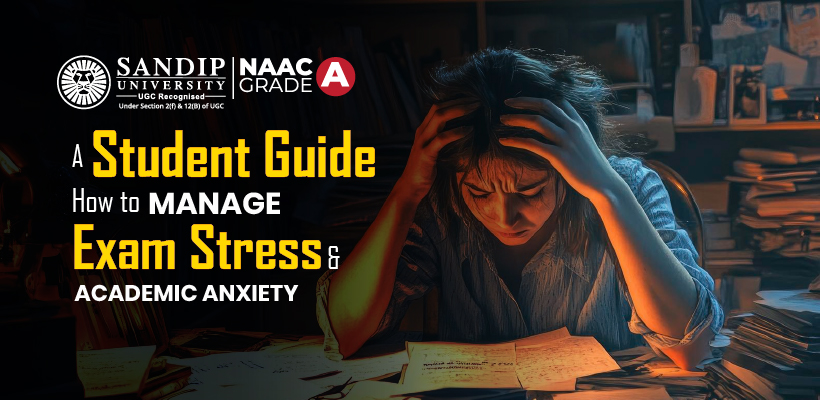
Exam anxiety is something we have all faced at a point in our lives. The late-night study sessions, group revision sessions, and the last-minute cramming sessions, we are familiar with them all. When academic anxiety adds up, your instant response could be to sink into a feeling of abject failure. Academic stress and exam anxiety are something all students deal with in their academic journey. However, not everyone has the tools related to exam stress management for students to help them deal with this problem. But worry not, there is a scientific way out of this situation that can help you manage academic stress and ace your exams.
Let us breakdown the science behind academic anxiety and exam stress, and then explore the guide on how to deal with this issue:
The Science Behind Stress: Why Does Your Brain Freeze?
Your brain’s stress alarm centre is the amygdala, responsible for the fight or flight response when confronted with stress. The amygdala releases cortisol into your system to help fight stress. A little cortisol is a good thing as it helps you focus.
However, when your stress and anxiety go into overdrive, your brain releases excessive cortisol, which floods the prefrontal cortex, basically shutting it down. The prefrontal cortex is responsible for critical thinking, logic, and memory revival. Hence, the part of your brain that is supposed to help you focus on your studies goes into survival mode by shutting itself down, adding to your already-existing stress and anxiety.
You cannot completely eliminate stress and anxiety; the best you can do is manage it in a way that helps you in preparing for your exams. Here is how you can consciously restructure your brain’s response to stress and anxiety for better academic performance:
How to Reduce Stress and Anxiety in College? A College Student’s Stress Management Guide
-
Make Your Biology Work for You
Your body and mind are your greatest asset. Use them to your fullest advantage by:
a) Prioritising Rest and Sleep: Pulling an all-night study session is like saving a file on a computer that does not have a hard drive. Instead, sleep for seven to nine hours or at least try for a twenty-minute power nap to improve cognitive function.
b) Brain Food vs Junk Food: High sugar foods can cause sugar crashes, stressing out an already anxiety-riddled brain. Instead, opt for complex carbs and proteins like nuts, fruits, and oatmeal that work as brain fuel.
c) Physical Fitness for Cortisol Reset: Exercise releases Brain-Derived Neurotrophic Factor (BDNF) that boost brain cells and memory by reducing cortisol levels. Even a ten-minute power walk can help reset a stressed-out nervous system.
-
Study Smart, Not Hard
Stress and anxiety are a direct result of feeling overwhelmed with a high academic load. Boost your perceived competence to help you study smart with:
a) Active Recall: Rereading notes has limited recall value. Instead, try active recall, where you read through a concept, then close the book and try to explain the concept out loud or write it down from memory to strengthen your neural pathways to this concept.
b) The Pomodoro Technique: Long study sessions may seem like the way to go, but our brain functions differently. Try to study with deep focus for twenty-five minutes, take a gadget-free break for five minutes to avoid cognitive failure.
c) The Spacing Effect: Instead of planning one long seven-hour study session over the weekend, try studying for one hour every day of the week. This spacing effect will make your academic load seem smaller and more manageable.
-
SOS Toolkit to Calm Your Mind
Your anxiety can be made worse through repeated patterns of negative thinking and cognitive distortions that make your problems seem bigger than they may be. Here are some study stress relief techniques for engineering students:
a) Calming Breathing Exercise: This technique consists of you breathing in for four seconds, holding your breath for seven seconds, and exhaling through your nose for eight seconds to flood your brain with oxygen and instantly calm your mind.
b) Opt for Stress Reappraisal: Scientific studies show that students who reframe their stress into excitement are able to focus better. Instead of thinking “I am stressed” think “I am excited or ready to study” to reframe your stress into excitement.
c) Combat Perfectionism: Instead of aiming for perfection, boost your confidence by practicing self-compassion. You should aim for consistent results, not perfect results, as one exam result does not decide the course of the rest of your life.
-
Managing Exam Room Panic
The day of the exam can be one of the most stressful events in a student’s life, which can be managed through simple techniques like:
a) Calm Breathing Technique: Exercise box breathing where you inhale for four seconds, hold for four seconds, release for four seconds, and hold for four seconds before taking the second breath to instantly regulate your nervous system.
b) Examine the Whole Paper: Instead of attacking the paper head-on, spend the first two to three minutes going through the entire paper and starting with the easiest questions first to give yourself the much-needed confidence boost.
c) Ground Yourself: In case of a panic attack, use the grounding technique. Make a note of five things, four things you can touch, three you can hear, two you can smell, and one you can taste to ground yourself in the present moment instead of panicking about the future.
Conclusion
These are some tips and tricks on how to focus while studying under pressure. Everyone handles stress and anxiety uniquely so there is no one-size-fits-all solution to these issues. However, you can keep this science-backed guide handy to manage your stress in a wholesome and healthy manner. Remember, one exam result cannot make or break your entire life, you are more than one marksheet. Good luck!
Start your stress-free academic journey with Sandip University today. Apply now!