
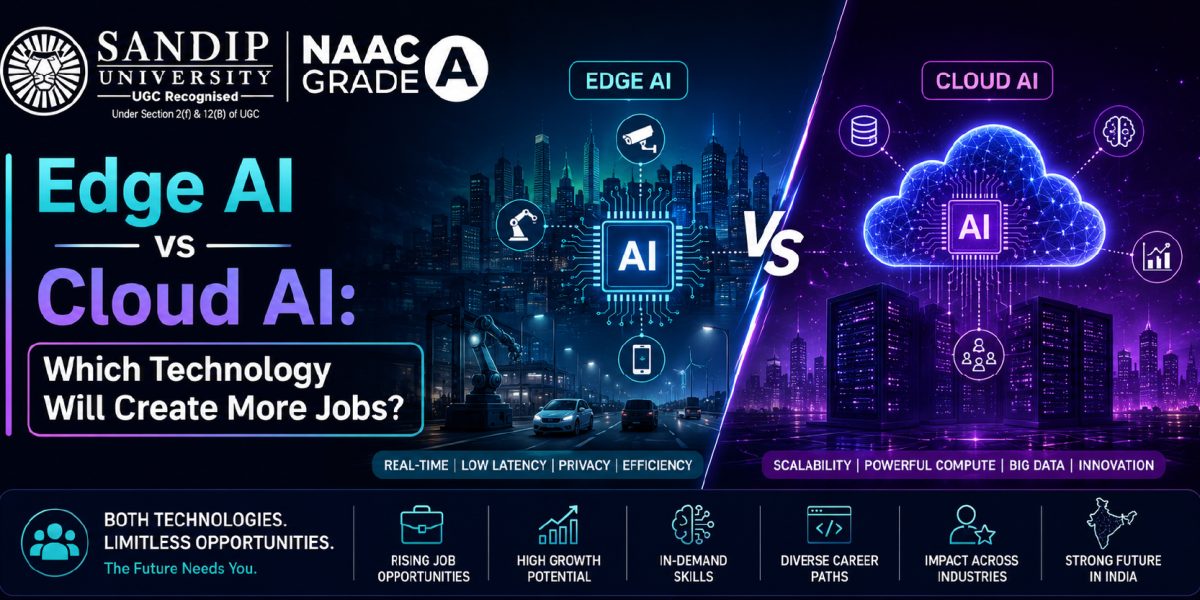
The tech industry is experiencing a massive shift as artificial intelligence moves from research labs to daily applications. This expansion triggers a critical debate about which architecture will dominate the future. Specifically, professionals want to know whether Edge AI or Cloud AI will create more employment opportunities.
Both technologies process data differently and each requires a distinct workforce. Cloud computing careers in India are definitely on the rise. Cloud AI relies on massive, centralised data centres. On the other hand, Edge Artificial Intelligence Engineering processes data directly on local hardware like smartphones, cars and factory sensors. Evaluating the core mechanics, infrastructure needs and industry adoption of both architectures reveals which technology will become the primary engine for job creation.
Let us compare these two technologies and understand their future career implications in detail:
What is the Difference Between Edge AI and Cloud AI?
Cloud AI centralises computational power. It sends data from local devices on the internet to massive data centres. These data centres house thousands of graphic processing units that train complex large language models and algorithms. The cloud offers virtually unlimited storage and processing power. However, it suffers from latency issues, high bandwidth costs and privacy vulnerabilities.
Edge AI is on the other end of the spectrum. Edge AI processes information directly on the physical device instead of sending data to an external server. A self-driving car cannot wait for a cloud server to tell it to brake. It must process visual data instantly. Edge AI eliminates latency, reduces bandwidth costs and keeps data secure on the device.
How Does Cloud AI Impact Jobs?
AI and Cloud Technology jobs currently commands a major share of AI investments. This translates into a mature and highly lucrative job market. The centralised nature of the cloud creates a massive demand for specific technical roles.
-
Impact Through Data Science and Machine Learning
Data scientists and machine learning engineers work well in the cloud ecosystem. They train cloud foundational models by using massive computational resources. These professionals also design complex neural networks, optimise hyperparameters and manage datasets. These roles focus on software, maths skills and algorithm design as cloud centralises data.
-
Impact Through Company Infrastructure
Cloud AI is dependent on infrastructural workforce. Companies need to employ cloud architects, data engineers and cybersecurity engineers to build and maintain these AI models. Data engineers have to design the infrastructure that moves information securely on cloud. Cybersecurity engineers develop relevant protocols to secure the data as it travels from users on to the cloud.
-
Impact Through Data Innovation
Cloud AI drives significant employment in data annotation and management. Large models require billions of clean, labelled data points. This necessity has created an entire global industry of data labellers, content moderators, and data quality analysts who prepare raw information for model training.
How Does Edge AI Impact the Workforce?
While Cloud AI dominates software and centralised infrastructure, Edge AI creates a massive wave of opportunities across hardware, software and field operations. Edge AI bridges the gap between digital intelligence and the physical world.
-
Impact on the Hardware Sector
The hardware sector experiences a massive renaissance due to Edge AI. Silicon engineers, semiconductor chip designers and hardware architects are in high demand. These professionals must design specialised AI chips, such as Neural Processing Units that deliver high performance while consuming minimal power. Hardware testing engineers and manufacturing specialists also see job growth as tech companies are embedding these chips into consumer and industrial devices.
-
Impact on the Software Sector
Edge AI requires a different breed of developer for software development. Embedded software engineers and firmware developers must rewrite AI models to fit on small devices. They use techniques like quantisation and knowledge distillation to shrink massive models without diminishing the accuracy. Software engineers in this space must understand both the limitations of physical hardware and the complexities of machine learning.
-
Impact on Field-based Jobs
Edge AI creates substantial field-based employment. Edge devices operate in the real world while cloud servers need climate-controlled rooms. Industries need IoT deployment engineers, field technicians and industrial automation specialists. This is to install and maintain smart devices in factories, cities, hospitals and agricultural fields.
Which Creates More Jobs: Cloud AI or Edge AI?
While Cloud AI will continue to generate high-paying software roles, Edge AI will ultimately create more total jobs globally. The reason lies in the sheer scale of deployment.
Jobs Through Cloud AI: Cloud AI limits its infrastructure to a finite number of data centres worldwide. Edge AI, however, scales into the billions of physical devices. Every smart home appliance, autonomous vehicle, industrial drone and wearable medical sensor requires an edge ecosystem to function.
Jobs Through Edge AI: Edge AI diversifies employment across multiple traditional sectors. It does not just create tech jobs for software engineers in Silicon Valley. It creates manufacturing jobs for chip plants, mechanical engineering jobs for robotics companies, installation jobs for field technicians and maintenance jobs for local infrastructure workers.
Edge AI merges the tech industry with manufacturing, automotive, healthcare and agriculture by embedding intelligence into physical objects. This convergence creates a much broader, more resilient and greater job market than centralised cloud computing can offer.
Both technologies work to complement one another. The two technologies often work together in hybrid models where the cloud trains the brain and the edge executes the actions. However, job seekers should position themselves strategically based on these market dynamics as the computer engineering career scope is vast. Explore B.Tech Computer Science Engineering at Sandip University Good luck!
Frequently Asked Questions (FAQS)
1) What is the difference between Edge AI and Cloud AI?
Edge AI processes data locally on devices whereas Cloud AI processes and stores data on external servers.
2) Which career has more opportunities: Edge AI or Cloud AI?
Both fields offer various job opportunities depending on your skills and aptitude.
3) What skills are required for Edge AI careers?
Students must be skilled in programming, AI model optimisation, hardware architecture and cross-functional skills for an Edge AI career.
4) Should engineering students learn both Edge AI and Cloud AI?
Yes, it is beneficial for engineering students to learn both Edge AI and Cloud AI.