
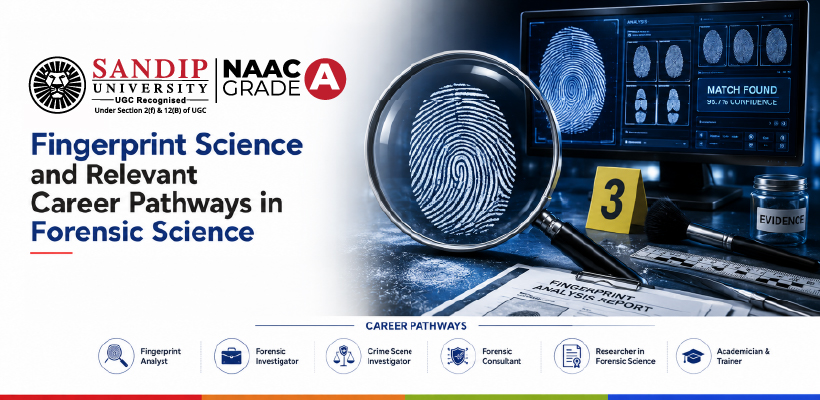
Long before DNA testing entered criminal investigation, fingerprint identification had already established itself as the primary method of confirming individual identity. The reason is simple, but the science isn’t. No two persons have the same ridge pattern, even identical twins. Once formed, that pattern is never changed from before birth until the skin itself expires at death. Uniqueness with permanence is a rare combination in biology, and it is this combination that has kept fingerprint science at the top of forensic practice for well over a century.
What is rarely stated in the beginning, however, is the extent of the territory within the field of work that this one area of study actually occupies. Fingerprint analysis is not one job. It is closer to a small ecosystem of roles, each demanding a distinct set of skills taught at some of the best forensic science colleges in Nashik and each sitting inside a field that India’s law enforcement and forensic infrastructure genuinely struggle to staff.
The Biological Basis of Fingerprint Uniqueness
The formation process begins early, between the tenth and sixteenth week of foetal development. Small pads on the fingertips, known as volar pads, grow and then regress at a specific rate. As they regress, ridges form on the skin’s surface, determined by the combined effects of three forces: the pressure from the shrinking pads themselves, the amniotic fluid surrounding them, and the specific position of the fetus in the womb at that instant. No two fetal positions are exactly the same, even for twins in the same womb at the same time. That’s why identical twins, even with the same genetic material, still end up with totally different ridge patterns. The uniqueness, that is to say, is mechanical as much as it is genetic, and that distinction matters. It is the reason fingerprint identification works even in cases where DNA evidence would fail to distinguish between two individuals.
Classification and Comparison Methods
There are three types of fingerprint patterns, such as loops, whorls, and arches. Loops dominate, appearing in roughly sixty to sixty-five percent of the population. Whorls follow at around thirty percent. Arches make up what remains. The classification system attributed to Sir Edward Henry at the end of the nineteenth century still forms the basis for the organisation and searching of fingerprint records today, more than a hundred years after its introduction.
But classification only narrows the field. It does not confirm identity on its own. That confirmation happens through minutiae analysis, a closer examination of specific ridge features, ridge endings, bifurcations, dots, islands, and spurs. Among these, ridge endings and bifurcations carry the most weight, and an examiner’s conclusion generally rests on how many of these points match between two prints and where those points sit relative to one another. It is worth noting that this process resembles pattern recognition far more than it resembles any kind of fixed coding system. There is no universal alphabet for a fingerprint. Each comparison is built from scratch.
The process of professional fingerprint analysis relies on a certain methodology called ACE-V, which is an abbreviation for Analysis, Comparison, Evaluation, and Verification. The analysis stage determines whether a recovered print even has enough clarity to proceed. A great many prints are discarded here before comparison ever begins. Comparison is the direct matching of minutiae. Evaluation is where the examiner commits to a conclusion, identification, exclusion, or inconclusiveness. Verification, the final stage, requires a second examiner to review the case independently, without knowledge of the first examiner’s decision.
Career Pathways Within Fingerprint Science
The proper education in fingerprint analysis can lead an individual to pursue more than one career pathway.
Latent print analysts use fingerprints found at crime scenes and other items as evidence, using fingerprint powders; cyanoacrylate fuming on nonporous surfaces like glass; and ninhydrin, which is used on porous surfaces like paper by reacting with amino acids in sweat to show blue-to-purple-colored ridge patterns. The career is largely connected with forensics units and forensic science laboratories in the state and is suitable for people that like outdoor and laboratory work equally.
Fingerprint analysts look at latent fingerprints. Compare them to records in databases. The ACE-V method is the main methodology used for analysis, which stands for Analysis, Comparison, Evaluation, and Verification. This method makes sure to conduct systematic analysis. Because of this process, each case can take many hours to complete. That makes it hard to get results.
AFIS operators, on the contrary, use automated systems to quickly find matches in large digital databases. This area of expertise is experiencing significant growth, propelled by escalating government and private investment in nationwide biometric technologies.
An expert witness performs a totally different function, where the role straddles both forensic science and law. It involves converting forensic information that relies on ridge analysis into something a courtroom, which is predominantly populated by people who do not have a scientific background, will be able to understand and assess. Very few professions in forensic science require such a mixture of technical expertise and clarity in communication.
Apart from these four, graduates may enter biometric security companies, fraud investigations in the insurance industry, forensic consulting, and teaching future generations of forensic examiners in universities. In summary, forensic science is a profession that does not confine its graduates to one particular path.
Addressing Skills Gap
India’s forensic infrastructure is understaffed, and this is not anecdotal. Police departments and state forensic laboratories across the country routinely report a backlog of cases, and a frequent reason given for the backlog is that there are not enough trained personnel to handle fingerprint analysis, DNA profiling and related disciplines. And it’s worth saying plainly to students weighing their options: A degree in forensic science isn’t fighting over a handful of scarce jobs. It is answering a demand that already exists and, by most accounts, continues to grow across law enforcement, government forensic services, and an expanding private sector built around biometric identification.
Limitations and the Continued Need for Trained Professionals
None of this should suggest that fingerprint science operates without error. It doesn’t, and pretending that it does is to do a disservice to anyone coming into the field. One of the most studied cases of misidentification in the history of forensics still remains the 2004 Brandon Mayfield case. A match to a fingerprint was verified independently by several experienced examiners, only to later discover that it was false and an American lawyer had been falsely linked to the Madrid train bombings. Subsequent research into the case pointed to contextual bias, the degree to which prior knowledge of a case can shapes an examiner’s judgment before comparison even begins, as a meaningful contributing factor.
Automated systems such as AFIS narrow possibilities. They do not decide outcomes. That responsibility still rests with a trained human examiner, and this is not a weakness to be engineered away so much as a permanent feature of the field. It is, if anything, the strongest argument for rigorous academic training over informal or shortcut routes into forensic work. A system dependent on human judgment cannot afford undertrained judgment.
Conclusion
Fingerprint analysis offers a truly elegant scientific foundation, along with a career landscape that, by most measures, remains underexploited by prospective students. Forensic labs, police forces, courts, biometric companies, and research facilities are all included in this category. And each one requires something slightly different in the way of strength, technical skills, patience, communication, and investigative instinct. For those students seeking some guidance as to what direction to take with their scientific inclinations, the B.Sc in Forensic Science and Criminology, including fingerprinting in the list of mandatory courses, presents not only a challenging program of study but also a relatively clear career track within the employment world.