
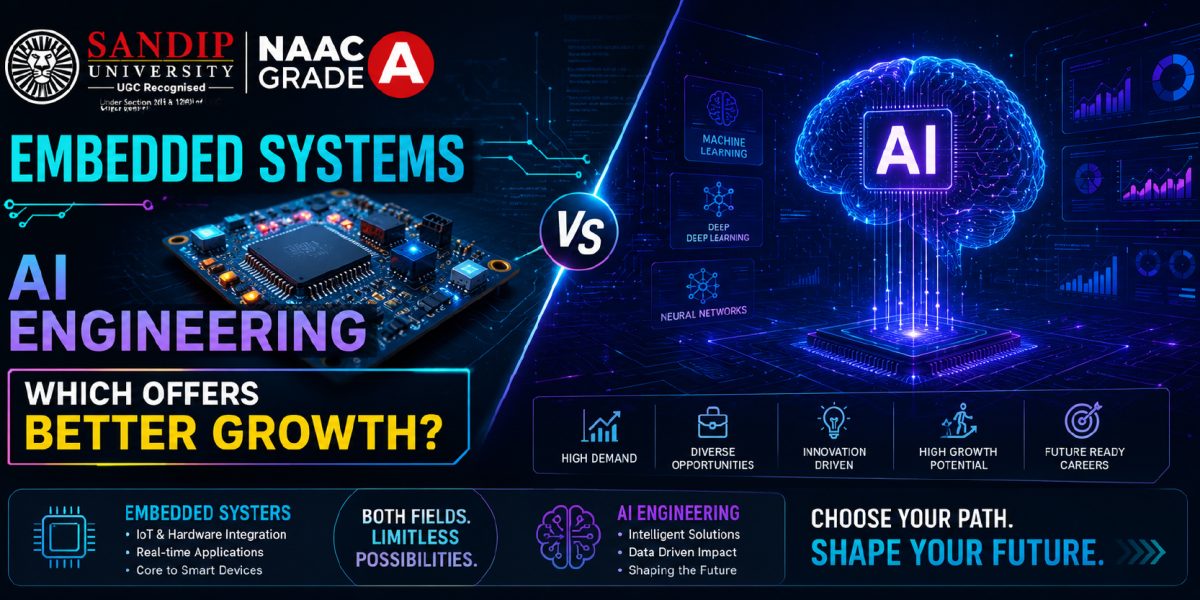
Technology is evolving at a staggering pace and choosing the right specialisation can define the future of your entire engineering career. For modern developers, hardware-focused enthusiasts and software architects, two domains command the spotlight, which are embedded systems and artificial intelligence engineering. Both fields sit at the cutting edge of technological innovation and are powering everything from smart home appliances to autonomous vehicles and massive enterprise data centres.
Let us explore embedded systems vs artificial intelligence and find out the right career path for you:
Understanding Embedded Systems Engineering
Embedded systems engineering connects the physical world with the digital world. Professionals in this field write software that is designed to control microcontrollers, microprocessors and hardware components.
Key Characteristics of Embedded Systems Engineering
There can be a resource constraint where there is a necessity that a code must run efficiently within limited RAM, flash storage, and processing clock speeds. Many systems operate under Real-Time Operating Systems where missing a deadline by milliseconds can cause catastrophic hardware failure. There is also a need for rigorous testing, static code analysis and compliance with safety standards.
Embedded Systems Engineering Career Opportunities
-
Firmware Engineer
These professionals focus on writing low-level hardware-near code that directly controls microcontrollers, and peripheral components. The expertise they provide serve as the backbone of consumer electronics, medical monitoring devices and industrial automation tools where code must execute with deterministic precision.
-
Embedded Software Architect
These professionals are tasked with designing the overarching software framework and hardware-software integration strategy for complex electronic products. They guide cross-functional engineering teams from concept to manufacturing to ensure that the products meet strict performance, memory and lifecycle requirements.
-
IoT Systems Engineer
These professionals connect resource-constrained physical devices and sensors to local networks and cloud infrastructure. The expertise they provide helps in powering smart home appliances, industrial IoT monitoring networks and smart city infrastructure.
-
Automotive Engineer
Automotive engineers develop safe electronic control units and software for modern vehicles like EVs. They ensure that the automobile industry is moving towards electrification of vehicles, autonomous driving and advanced digital ecosystems that are used inside the vehicle for a futuristic driving experience.
-
Robotics Firmware Engineer
These professionals program microcontrollers in motion sensors that ensure actuation in robotic systems. These robotics engineers are making waves in industries like manufacturing, automobile industry, the drones sector, and healthcare due to automated robots.
Robotics firmware engineers are responsible for programming microcontrollers in motion, sensory perception and real-time actuation in robotic systems. These professionals also help build industrial robots, automated guided vehicles, surgical robots and autonomous drones for further innovation in this field.
Understanding AI Engineering
AI engineering focuses on building futuristic software pipelines and computational models that enable machines to learn from data and make automated decisions.
Key Characteristics of AI Engineering
There is a heavy reliance on linear algebra, calculus, probability and large-scale data processing so professionals must have a mathematical mindset. It also requires massive cloud compute resources, distributed GPU clusters and specialised hardware accelerators. There is a need for constant adaption and upgradation as ecosystems and model architectures shift rapidly.
Career Opportunities in AI Engineering
-
Machine Learning Engineer
Machine learning engineers are connecting data science with production software. They design and train machine learning models based on the analysed data. They also build fraud detection algorithms and predictive analytics tools that can be used in industries like fintech, e-commerce and healthcare.
-
Machine Learning Operations Engineer
Machine learning operations engineers have to oversee the lifecycle of machine learning models to ensure that they are functioning in a productive manner by using DevOps practices. They make sure that all the AI applications are scalable without compromising on performance due to large user volumes.
-
Computer Vision Engineer
These professionals enable machines to extract meaningful information and insights from digital images and video streams. Their skills power autonomous vehicle perception, facial recognition security systems, automated medical imaging diagnostics and quality control vision systems in smart manufacturing.
-
Natural Language Processing Engineer
These professionals build computational models capable of understanding, interpreting and generating human language text. Their expertise drive systems like enterprise chatbots, language translation engines, automated customer support and legal document review software.
-
Generative AI Engineer
These professionals harness foundation models and large language models to create novel content, automated workflows and interactive conversational agents. They also help innovate on creative software, automated code generation assistants, enterprise knowledge management and personalised customer engagement tools.
How do AI Engineering and Embedded Systems Engineering Combine?
The rigid boundary between embedded systems and AI engineering is actively dissolving through Edge AI and tiny machine learning. Modern devices require artificial intelligence models to run locally on resource-constrained microcontrollers. Computer engineering future jobs favour engineers who understand both low-level hardware constraints and machine learning mathematics command extraordinary market value.
Which is the Right Career Choice for You?
The question remains, which is the right career path for you as per your career goals with a B.Tech in Computer Engineering? Here is how you can make the right choice:
- Choose AI Engineering if: You are comfortable with mathematical innovation, large datasets and want to be a part of the software transformation.
- Choose Embedded Systems Engineering if: You want to build physical products, want engineering stability and enjoy solving complex puzzles.
Conclusion
The choice between embedded systems and AI engineering ultimately depends on your interests. The most important professional vision today is not about choosing one over the other, but recognising where they meet. Engineers understand both domains will find themselves equipped with the knowledge and skills from one of the top engineering colleges in Nashik for a bright career ahead. Assess your personal strengths and choose the path that goes with the future you want to build. Good luck!
Frequently Asked Questions (FAQs)
What is the difference between Embedded Systems and AI Engineering?
Embedded systems is all about building hardware and firmware that interact with the real world and AI engineering is all about creating algorithms and models to automate machines.
What skills are required for Embedded Systems careers?
You need to know programming, hardware knowledge and real-time operating concepts for a career in embedded systems.
What skills are required to become an AI Engineer?
You need to know programming, machine learning, software architecture and system evaluation skills to become an AI engineer.
Can engineering students learn both Embedded Systems and AI?
Yes, engineering students can learn both embedded systems and AI.