
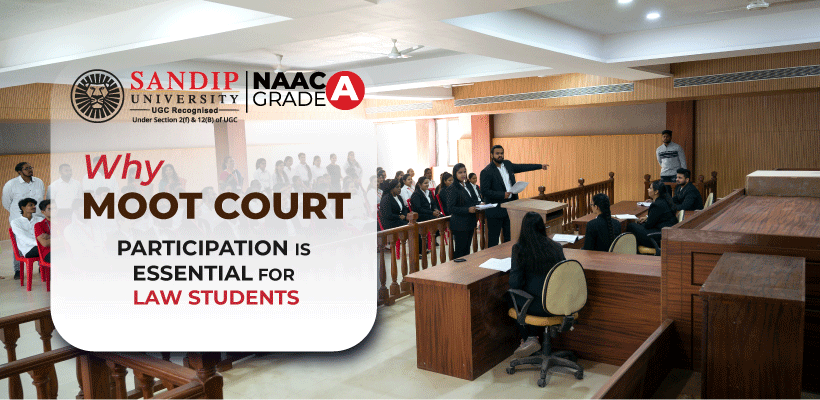
Moot court participation is an essential part of law education for practical legal training of students. Moot court participation fosters skill development, professional career growth, and practical knowledge building opportunities. The goal is to help students develop practical and soft skills, learn to work in a team, think quickly on their feet, solve problems on the go, and boost career growth. Some of the best law colleges in Maharashtra have a dedicated moot court on campus to help students access top-notch law education.
Let us take a deep dive into the various benefits of moot court participation for law students, and understand the moot court culture at Sandip University:
What are the Advantages of Moot Court Participation for Law Students?
There are ample advantages of moot court participation at the college level. It ensures law student skill development by blending courtroom sessions with skill-building activities at the practical and theoretical levels. Here are some top benefits of moot court participation for law students:
1. Skill Development
a) Advocacy Skills
Students build written and oral advocacy skills through moot court participation. They are able to construct sound arguments and counter arguments, work out challenging scenarios, build persuasive speaking skills, and work on legal writing skills that prepare them for a challenging career in law.
b) Legal Research Skills
Law is a very research-heavy field with the need for extensive researching skills. Students need to know which cases to refer to, work out which kind of arguments work in which scenarios, and understand complex legal principles and apply them to hypothetical cases to prepare for real-life legal challenges.
c) Industry-relevant Soft Skills
Moot court participation ensures that students develop industry-relevant soft skills. Students build skills like problem-solving, analytical thinking, creative thinking, teamwork, strategic planning, communication skills, public speaking skills, and critical thinking skills through moot court participation.
2. Professional Career Growth
a) Simulation of Courtroom
Moot court is an exact simulation of a courtroom, preparing students to confidently transition from the moot court to a court of law. Students gain a realistic understanding of legal proceedings, how to present arguments, follow courtroom protocol, and follow apt procedures pertaining to the courtroom.
b) Real-time Application of Law
Students who participate in moot court sessions gain first-hand and real-time understanding of how law is applied to complex cases. They are able to apply legal concepts learnt in the classroom in the practical setting of a moot court, preparing them for a smooth integration into the Indian judicial system.
c) Networking Opportunities
Networking is an important aspect of legal education in India. A strong mooting experience that includes rubbing shoulders with advocates, judges, and industry mentors can help students gain access to the industry, creating opportunities for internships and placements in the long run.
3. Practical Knowledge and Experience Building
a) Experiencing the Courtroom
Students gain advocacy skills in law and practical legal training through moot court participation. Students gain first-hand understanding of how a court of law functions. They are better-equipped to work in a high-pressure real-world scenario upon graduation after moot court participation at the college level.
b) Resume-building Opportunities
Moot court sessions play an important part of legal education in India. Top law firms and organisations seek professionals who have active moot court participation mentioned in their resume, especially for freshers. It plays a monumental role in enhancing and building your resume and helping you stand apart from your peers in the job market.
c) Confidence and Personality Development
Strategic moot court participation by students is bound to help them build their confidence and develop their overall personality. This plays an important role in transforming them into suave legal advocates who can either join top law firms in India, or go into independent practice, depending on their career goals.
What is Sandip University’s Moot Court Culture?
Sandip University’s School of Law (SOL) is one of the top law colleges in Nashik with a thriving mooting culture, which includes:
1. Dedicated Moot Court: The University has a dedicated moot court where students gain access to knowledge and skill building opportunities at the college level. The moot court is designed to emulate a real court of law for advanced student development.
2. National-level Competitions: Sandip University annually organises national-level moot court competitions. Law students from top law schools in India participate in these competitions, helping students pit their skills and knowledge against their peers.
3. Soft and Practical Skill Building: Moot court participation at Sandip University helps students build soft and practical skills like critical thinking, persuasive speaking, legal research, confidence, teamwork, and other skills essential for success in the court of law.
4. Networking Opportunities: Top lawyers, High Court Judges, and legal professionals regularly conduct guest lectures and are invited to various events conducted at Sandip School of Law. This helps students build a thriving network that can translate into internship and placement opportunities upon graduation.
Conclusion
Moot court participation is definitely essential for law students as it helps them apply theoretical knowledge in real courtroom scenarios. They become more competent and industry-ready for a career in the legal profession. Sandip University’s mooting culture is designed to transform students into sharp legal minds that can take on the challenges of the legal system and emerge victorious. Pursuing a law degree from Sandip University can help you set your law career on the path of success!